Instrument Design problem.......
-
@dannytaurus said in Instrument Design problem.......:
What do you mean? I just asked Claude to read the post and suggest a solution.
Claude stated that the interface script is deferred, when it isn't. There is nothing in this thread to indicate it is but I'd figured from Lindon's post that is isn't and Lindon has confirmed that now.
I find Claude (AI in general) makes assumptions and states them as facts. That wastes tokens and waste my time chasing down an empty rabbit hole.
Free HISE Bootcamp Full Course for beginners.
YouTube Channel - HISE tutorials
My Patreon - More HISE tutorials -
@David-Healey Yeah, all AI models make mistakes. I often challenge anything that doesn't sound right. It will just apologise and course correct.
HISE dev latest / herdr + Claude Code / Figma + Affinity
Meat Beats: https://meatbeats.com
Klippr Video: https://klippr.video -
@David-Healey said in Instrument Design problem.......:
If you do need to script it I'd put this stuff in a separate MIDI processor and leave the interface deferred.
Claude may have picked it up from this line. I had it read the whole topic, not just Lindon's original post.
-
@dannytaurus Yep that's the way. The problem is if you don't know that what it's said is incorrect you can't challenge it.
@dannytaurus said in Instrument Design problem.......:
Claude may have picked it up from this line.
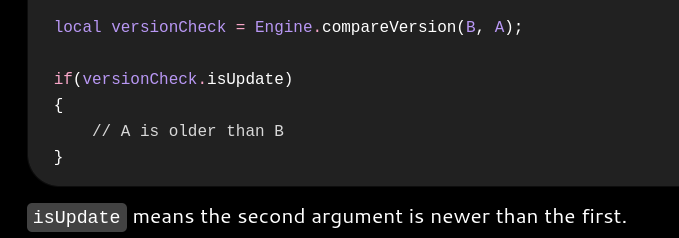
Yes, and in context I'm suggesting to Lindon that he defers his non-deferred Interface script and instead uses a separate non-deferred MIDI processor,
Free HISE Bootcamp Full Course for beginners.
YouTube Channel - HISE tutorials
My Patreon - More HISE tutorials -
The problem is if you don't know that what it's said is incorrect you can't challenge it.
Same as humans. And the HISE documentation, for that matter!

-
@dannytaurus
For this reason I only ever use AI to advise with code, if it's something with an instantly falsifiable result (eg. that math was supposed to result in a flat frequency response, but we measured ripples, therefore it failed). Making it reason about abstract problems and solutions still performs very badly in the absence of good measurement tools to determine sucess.Actually, even if an Agent is in a good feedback loop where it can run the code in question, and check the result of its idea, I've found that it still ends up cheating the problem and writing the code in a way that will come back to bite you later, even if the immediate answer is correct.
Perhaps it will continue to improve, the advancements in this field have been speedy indeedy.
-
@griffinboy Respectfully disagree. My experience is overwhelmingly positive.
Context:
I code with agents 3-4 hours every day, often longer, and I only use the best models available.
With respect to HISE, the agents have access to the full HISE and JUCE source code, the documentation website, the MCP server and CLI tools.
The rest of my work with agents is on Ruby on Rails web applications, static websites, business intelligence and planning, and brainstorming. Quite a wide range.
HISE dev latest / herdr + Claude Code / Figma + Affinity
Meat Beats: https://meatbeats.com
Klippr Video: https://klippr.video -
@dannytaurus
That's interesting!
Maybe we are working on different kinds of projects?I've been using GPT Astra Max, for DSP science. And I've found it to not be "clever enough" with it's coding. Part of the problem is likely that a lot of DSP solutions are proprietary and so there is a gap in it's knowledge, but even when I supply the solutions, the code (or advice) produced, is short sighted, and blocks off many quite important optimizations down the line if I were to take it's advice seriously.
And without a very good measurement harness (super-resolution frequency response, phase, sidebands, etc), it wasn't able to QA audio properly either to realize that its solution was nonsense.
It's the kind of thing where I think many people would take it's word for it as well.
Custom C++ DSP (for commission)
-
@griffinboy Yes, different projects indeed.
I can see agents and models lacking the detailed-oriented work necessary from your work, but it's a stretch to extend the 'false positives' arguments to all agents/models across all work.
In your case, the amount of resources the agent has to refer to is key. Exactly the 'gap in knowledge' that you mentioned.
HISE dev latest / herdr + Claude Code / Figma + Affinity
Meat Beats: https://meatbeats.com
Klippr Video: https://klippr.video -
@griffinboy By the way, do you know that agents will happily decompile binaries now? For research purposes only of course.
'Proprietary' is starting to lose meaning.
HISE dev latest / herdr + Claude Code / Figma + Affinity
Meat Beats: https://meatbeats.com
Klippr Video: https://klippr.video -
@dannytaurus
You're probably right, that it's more than good enough for a wide variety of tasks!The knowledge gaps become an issue in fields where information is less free. And noticeable in fields where small imperfections = failure.
However, I've also had to trundle through quite a lot of entirely vibecoded codebases lately from various clients and there have been some horrible dumpster fires
 lol.
lol.
So my perspective is probably a bit tainted by these experiences!
-
@dannytaurus
That much is true.
Technically.
Not legally, by the way.
At least not where I am, in the UK.You can decompile software partially and only in the case that you're making a piece of software that needs to be compatible with the thing you are decompiling. Not so that you can learn it's inner workings for any other reason.
My loophole was to go and talk to a large number of developers about their works.
It cost a lot of money and time to do the interviews, but that's one way to gain a lot of knowledge on a subject, learning personally from the best in each discipline. No decompiling needed.(sorry Lindon! I've messed up your thread a little)
-
Haha at this point it‘s a meme - whenever Lindon asks something we all share our experience with random LLMs…
-
This is the kind of nonsense that makes my head hurt.
Free HISE Bootcamp Full Course for beginners.
YouTube Channel - HISE tutorials
My Patreon - More HISE tutorials -
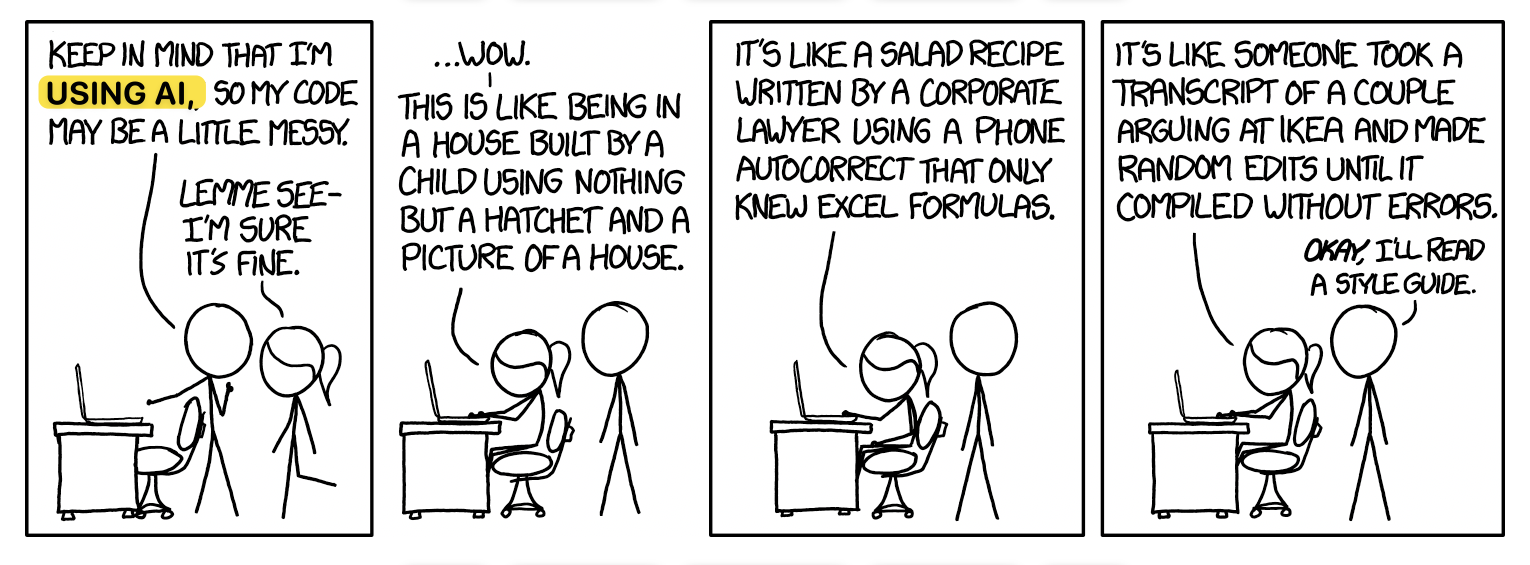
@David-Healey As usual, xkcd has an appropriate comic (with just a small edit)
HISE dev latest / herdr + Claude Code / Figma + Affinity
Meat Beats: https://meatbeats.com
Klippr Video: https://klippr.video -
anyways, back to the original problem. I'd say you have two options:
- Use a script voice start modulator if all the parameters have a corresponding mod chain (gain, pitch & filter all have that). The logic of selecting the next value from your array can be calculated in the onVoiceStart callback and if the mod target is rendered polyphonically (which is the case for pitch, gain & filter), then everything should be click free as the rendering pipeline is reset before starting the voice.
- Make a custom FX with either an extra mod chain, then go back to 1 for other modulation targets.
I wouldn't touch event data here if you get by with scripted voice start.
-
@Christoph-Hart thanks for getting this back on track...OK well Im using a Hardcoded master FX to host my filters as they are korg and obi models not available in HISE, and Im using(not that Ive mentioned it) another HCFX for the FM modulation as FM mod seems to be broken in Syntheseiser groups now....So i think this points me down path 2, which is a problem as I have no idea how to script an extra mod chain to respond to note on and get an array value with a counter...
HISE Development for hire.
www.channelrobot.com -
Ok so after some simple dickering about on my part I can report (unsurprisingly) @Christoph-Hart 's approach 1 works fine for "std" modulators and FX and for Hardcoded FX too.. so all good here.....
HISE Development for hire.
www.channelrobot.com -
@Lindon so can we finally get back to discussing whether Claude was better 1 month ago please?
-
@Christoph-Hart have at it.....